


02 / STRATEGY
Power without complexity.
The design direction balanced serious enterprise depth with an approachable first-use experience. Clarity over decoration, progressive disclosure, consistent interaction patterns, and predictable navigation became the guardrails for every product surface.
01
Reframe the builder around agents, not scripted flows.
02
Make complex enterprise workflows easier to navigate and understand.
03
Create a unified language that could extend to AI-native features.
03 / DESIGN SYSTEM
A system made the platform shift shippable.
Semantic tokens replaced arbitrary values, while a structured type scale and repeatable component rules made product quality consistent across Dashboard, Builder, Analytics, Settings, authentication, onboarding, and the new agent-native surfaces.
FOUNDATIONS • Color tokens • Type scale • Spacing • Grid • Elevation • Radius • Motion • Icons
CORE COMPONENTS • Buttons • Inputs • Tables • Cards • Tabs • Tags • Toasts • Empty states • Modals • Search
AGENT BLOCKS • AI Agent • Data Extractor • Categorizer • Knowledge Base • Tool Calling
04 / TRANSFORMATION
From fragmented surfaces to an agent-native platform.
NAVIGATION / A cluttered single rail became a dual navigation model: primary sections stayed reachable while a secondary panel revealed detailed options without losing context.
BUILDER / Gambit nodes for scripted decision trees made way for AI Agent, Data Extractor, Categorizer, and tool blocks on a canvas designed for connected agent workflows.
OPERATIONS / Dashboard, data views, analytics, onboarding, and settings were rebuilt around agent performance, debugging, discoverability, and time-to-first-agent.
05 / ROLLOUT & IMPACT
A phased rollout kept enterprise teams moving.
Phase 1: foundations and dual navigation. Phase 2: dashboard, workspace, and agent management. Phase 3: the canvas, knowledge, tools, and integrations. Phase 4: data views, analytics, settings, login, and onboarding. Design QA ran continuously so improved usability never became a disruptive reset for enterprise teams.
SAMPLE METRICS · ↓ 41% time to first agent · ↓ 36% navigation clicks · +23% onboarding completion · 140+ reusable blocks · ↓ 68% design inconsistencies
All metrics are invented sample data for preview only — not measured outcomes.
06 / LEARNINGS
A platform shift is a design problem — not just an engineering one.
Moving from chatbots to agents demanded a new core mental model for the canvas, blocks, and navigation. The system was product strategy: it made the transition possible in phases. Consistency built trust, while progressive disclosure made the new AI power feel usable rather than overwhelming.
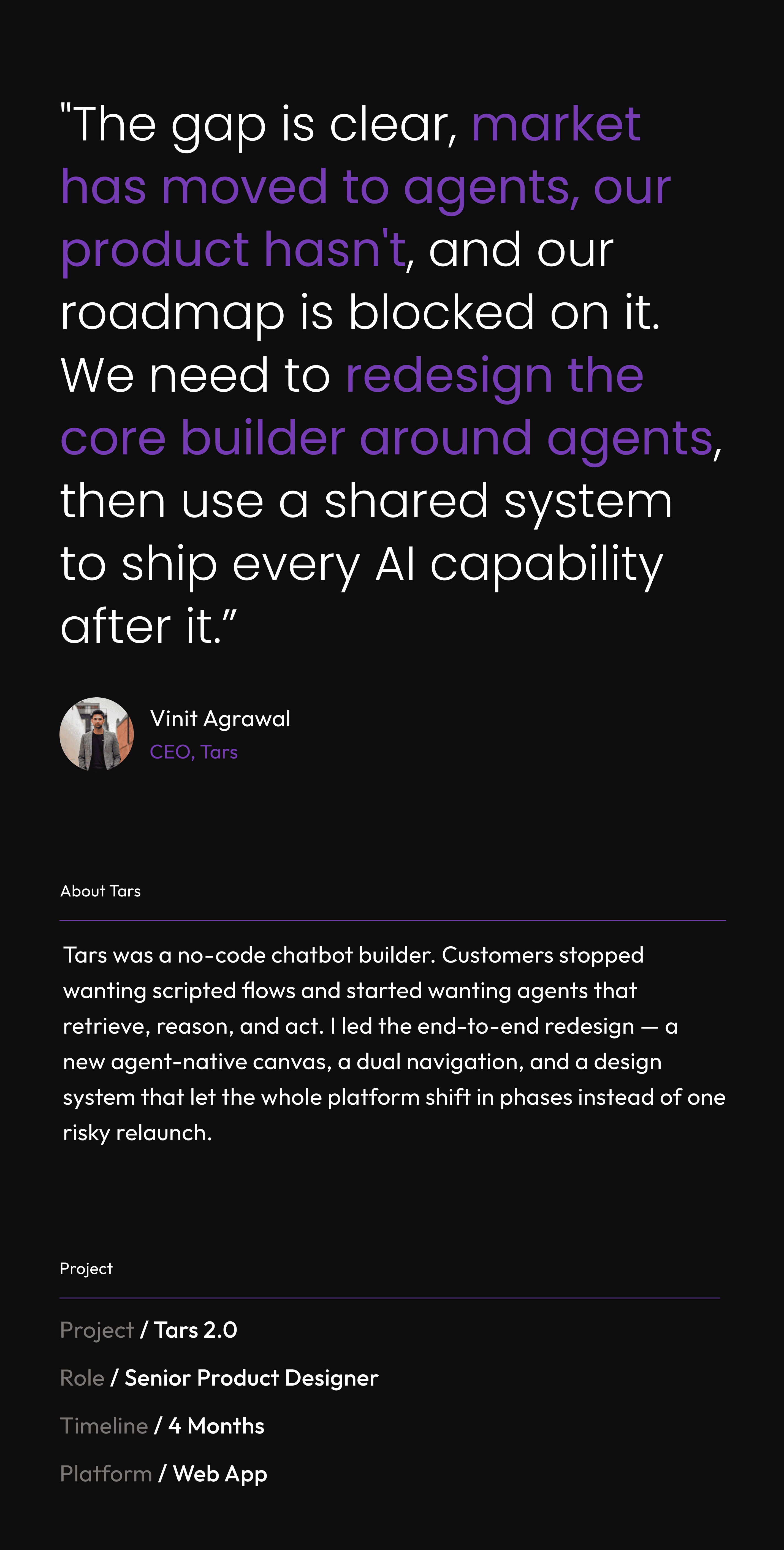
I led the end-to-end redesign: the audit, information architecture, dual navigation, agent builder canvas and blocks, visual language, component system, interaction patterns, dev handoff, and design QA.
NEXT PROJECT / Siru — 0→1 hyperlocal ecommerce platform